How to Build Stronger Retaining Walls
Become strong, long-lasting retaining walls past learning how to properly build a wall.
How Soil 'Pushes' (and How to Build a Retaining Wall that Pushes Back)
When you contemplate how to build a retaining wall, you may imagine how firm and solid it'll announced from the front, or how nifty the new garden will look above it. Simply unless you requite serious thought to what goes on behind and beneath the wall, the retaining wall pattern may not wait skillful for long. A poor retaining wall design wall can lean, split up, even topple — you don't want that.
Lots of people think a retaining wall needs to concord back all 6 gazillion tons of soil in the chiliad behind information technology. It doesn't. It only needs to retain a wedge of soil, or elongated wedge of soil, similar to that shown in the image below.
In uncomplicated terms: Undisturbed soil — soil that has lain untouched and naturally compacted for thousands of years — has a maximum gradient beyond which it won't 'hang together' on its own. This slope is chosen the failure aeroplane. If left alone, the soil behind the failure plane will stay put on its own. But the soil in forepart of the failure plane — the natural soil or the make full yous're going to add — wants to slide downwardly the failure plane.
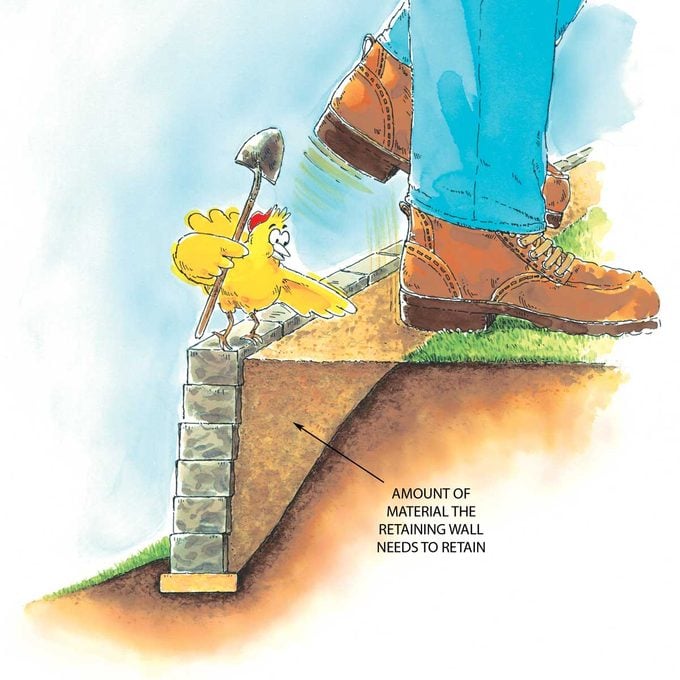
Gravity, along with the slope, directs nigh of the weight and pressure of the fill up toward the lower part of the retaining wall. Since soil weighs a bulky 100-plus lbs. per cu. ft., you lot need some pretty heavy material — large retaining wall blocks, boulders, timbers or poured concrete — to counteract the pressure. Just as important, information technology needs to be installed the right way. Here are three fundamental principles in edifice any solid retaining wall:
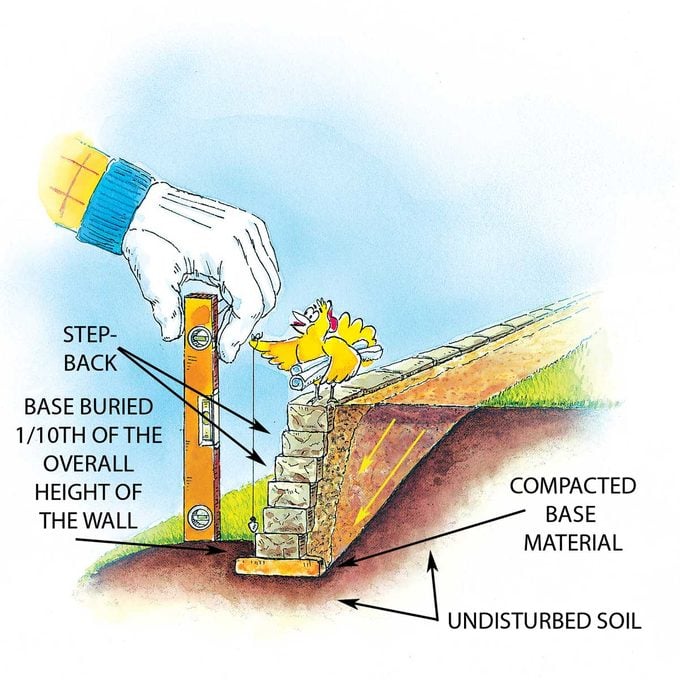
- Coffin the bottom course, or courses, of the retaining wall one tenth the acme of the wall to prevent the soil behind from pushing the lesser out.
- Step back the blocks, rocks or timbers to go gravity working in your favor. This lets the walls lean and push against the fill. Walls congenital perfectly vertical get gravity working against them the 2d they start leaning outward even just a fleck. Near concrete retaining wall block systems have some kind of built-in lip or pin organization that automatically creates the stride back every bit yous build.
- Install a base of operations of solidly compacted textile and so your wall stays apartment. A level wall provides modular blocks, stone and timbers with more surface contact with the courses above and beneath them. They fit together more tightly. The more contact, the more than friction and the stronger the wall. Use these 3 rules, and you'll create a strong wall. But even a well congenital wall won't survive unless y'all take care of two troublemakers: h2o and uncompacted soil.
Uncontrolled Water Weakens Walls
Water tin can weaken retaining walls by washing out the base cloth that supports the wall. But far more than frequently, it causes problems by edifice upwardly behind the wall, saturating the soil and applying incredible pressure. That'southward when walls commencement leaning, jutting and toppling. Well built walls are constructed and graded to prevent h2o from getting behind the wall and to provide a speedy go out road for water that inevitably weasels its manner in.
Take a expect at the well-drained wall below on the left. The sod and topsoil are almost even with the top block, so surface h2o flows over the top rather than puddling backside. Just below that is 8 to 12 in. of packed impervious soil to help prevent h2o from seeping behind the wall. The gravel below that soil gives water that does enter a fast route to the bleed tile. And the perforated bleed tile collects the water and directs information technology away from the base of the wall, escorting information technology out through its open ends. In that location'due south zippo to preclude water from seeping out between the faces of the blocks, either; that helps with the drainage besides. The wall even has porous filter fabric to forestall soil from clogging up the gravel. What you're looking at is a well-drained wall that will last a long time.
At present look at the poorly drained wall below on the correct. There's a dip in the lawn that collects water well-nigh the height of the wall. In that location'south no impervious soil, then the water heads south, slowly water-logging and increasing the weight of the soil packed behind the wall. The homeowner put plastic against the back of the wall to foreclose soil from oozing out betwixt the cracks — merely information technology'south too holding water in. Yikes! There'southward no drain tile at the bottom — the trapped water tin soak, soften and erode the base material. Non simply that, an excavated trench that extends below the base lets h2o soak into the base of operations textile and weaken it. You've got a retaining wall that has to hold dorsum tons and tons of water and saturated soil — and when that water freezes and expands in the wintertime, matters get even worse.
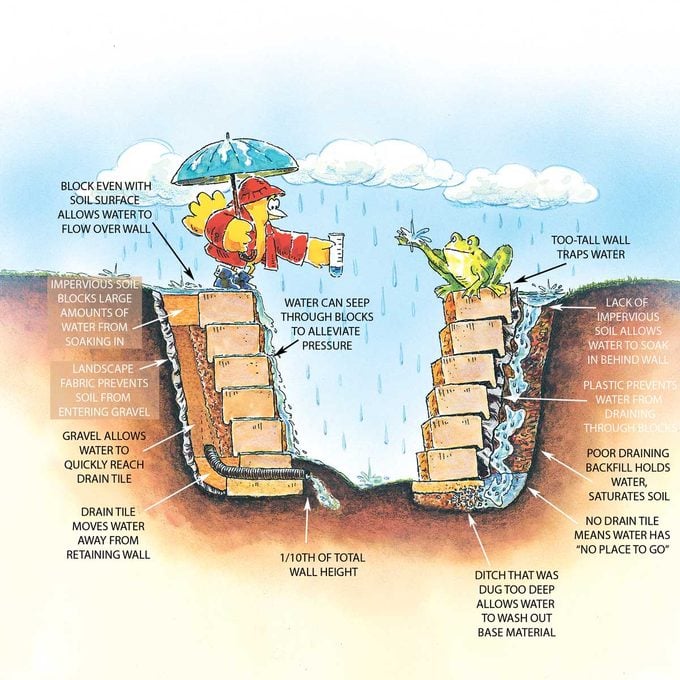
A Well-Congenital Wall
A strong retaining wall blueprint features well-compacted base of operations material, compacted material in front of the wall to prevent boot-out, and stepped-back materials.
A Poorly Congenital Wall
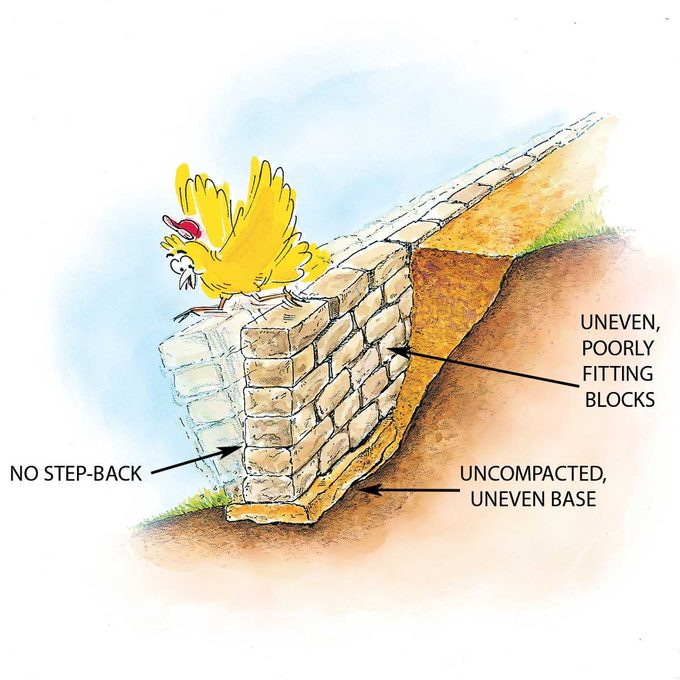
A wall that has an uneven base, no compacted material in front of it and no pace-back to the materials will somewhen fail.
Poor Compaction Adds Force per unit area to Walls
Even if you have only a small wedge of soil to retain, compaction is important. If your failure airplane is farther dorsum so your wall needs to retain more fill, weight and pressure, then compaction and a reinforcing filigree become critical. These two things help increase internal friction and direct the force per unit area of the fill you add downwardly, rather than at an angle pushing against the wall. Good compaction doesn't mean dumping a couple of feet of make full behind the wall, then jumping up and down on it in your work boots.
Proficient compaction means calculation 3 or four in. of textile, compacting information technology with a heavy, noisy vibrating plate tamper from your friendly neighborhood rental thou, and so repeating these steps over and over. Your landscape supplier or cake manufacturer (if you're using modular blocks) tin tell you whether you lot demand to install reinforcing grid, and at what intervals. The taller the wall, the more likely you'll need reinforcing filigree.
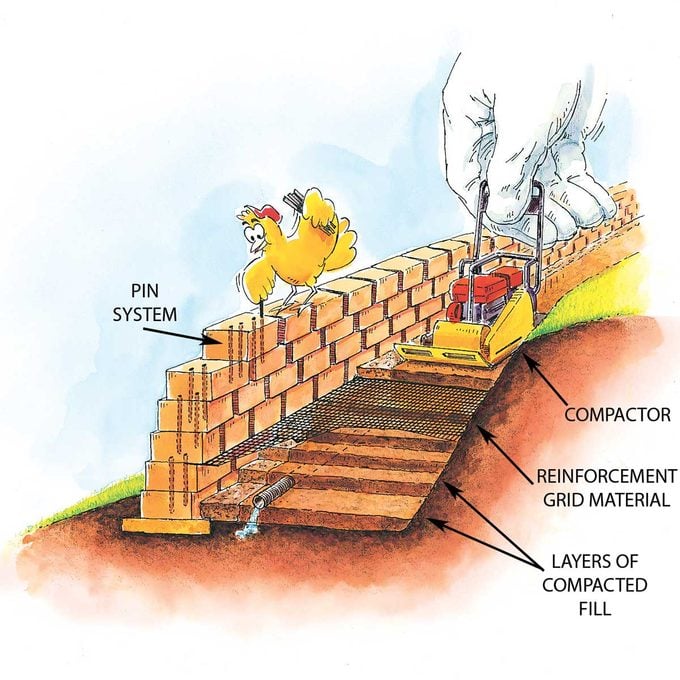
When building a retaining wall, never backfill with, or meaty, topsoil; it will break down and settle, creating a water-welcoming trench behind your wall. Use sandy or gravelly materials, which compact much better. And e'er brand sure y'all don't become overzealous and compact your wall outward.
Timber Walls, Alpine Walls, Edifice Codes and Other Stuff
Past themselves, mural timbers and a railroad tie retaining wall lack the weight to hold back soil. To make these walls strong, y'all demand to add "dead men," anchors that lock the wall into the soil behind them. The aforementioned pressure that's pushing against the wall pushes downwardly on the dead men to keep them (and therefore the wall) in identify. The principles of stepping back, installing good drainage and compacting as well apply to timber walls.
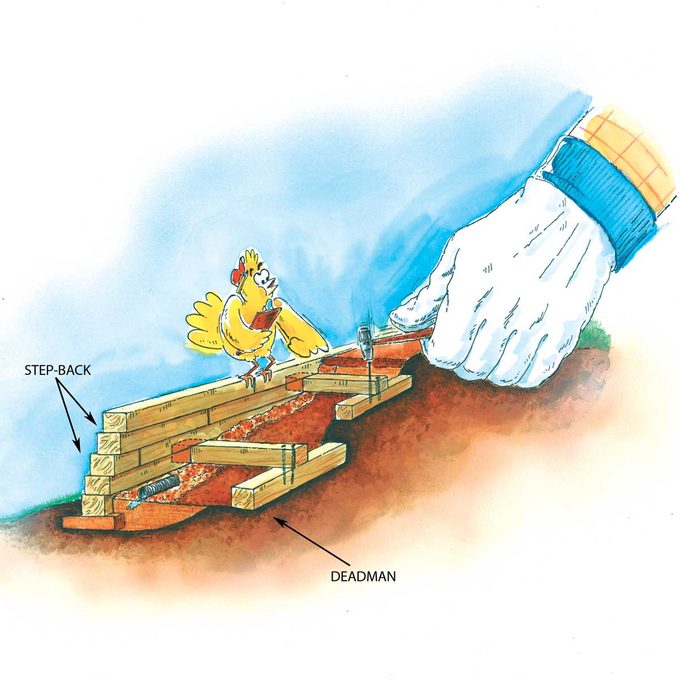
Walls of whatsoever material that are taller than iv ft. play by the aforementioned rules — it's just that the wedge of soil is too big and heavy to be held in place by the weight of the materials alone. Some communities now require edifice permits and construction details for walls exceeding iv ft. in tiptop. We remember that's a good idea too. Many modular block manufacturers tin can supply printed sheets of structural data.
For tall slopes, a serial of tiered walls is a good substitute for a single tall wall. Simply an upper tier can utilise pressure level to a lower tier unless it's spaced the proper distance—you know, behind the failure plane. The rule of thumb is to set back the upper wall twice the meridian of the lower wall.
Source: https://www.familyhandyman.com/article/how-to-build-stronger-retaining-walls/

Post a Comment for "How to Build Stronger Retaining Walls"